
Training Day Games Adults Won't Hate: 16 That Earn Their Place
Adults will do almost any training activity if two things are true: it takes less time than the thing it illustrates, and it doesn't ask them to perform in front of colleagues.
These all earn their place - each one demonstrates something you'd otherwise spend twenty minutes explaining on a slide.
Cards for the people you work with
Leaving cards, thank you cards and retirement cards, blank inside, drawn and printed by us in the UK. Big enough for the whole office to sign.
 Whose Gonna Make The Brews Now? Leaving Card
£3.87
Whose Gonna Make The Brews Now? Leaving Card
£3.87
 Good Luck For Your New Life in Dubai Card
£3.87
Good Luck For Your New Life in Dubai Card
£3.87
 Police Officer Retirement Card (Less Time For Murder)
£3.87
Police Officer Retirement Card (Less Time For Murder)
£3.87
 Good Luck In New York Moving Away Card
£3.87
Good Luck In New York Moving Away Card
£3.87
 Good Luck Down Under Moving to Australia Good Luck Card
£3.87
Good Luck Down Under Moving to Australia Good Luck Card
£3.87
 Kick Back Funny Capybara Retirement Card
£3.87
Kick Back Funny Capybara Retirement Card
£3.87
Activities that teach communication
- Back-to-back drawing - one describes, one draws. The perfect five-minute lesson in briefing.
- Chinese whispers with a genuine work instruction. Painful and useful.
- One-sided instruction: a facilitator gives instructions and can't answer questions. Demonstrates why people ask.
- The paper folding exercise - same verbal instructions, everyone folds differently.
Activities that teach process and planning
- Marshmallow or paper tower challenge - teams that prototype early beat teams that plan for ten minutes.
- The scrambled process cards - reorder a real workflow, argue about the order.
- Ball pass: get a ball through everyone's hands in the shortest possible time. Teams get from ninety seconds to under two, and the point about iteration lands.
- Penny game or dot game for batch versus flow, if you're doing anything lean.
Activities about decisions and priorities
- Desert island ranking - individually, then as a group. Groups beat individuals almost every time.
- Spend the budget: teams allocate a fixed pot across real options and defend it.
- Stop, start, continue in small groups, then merged.
- The consequences exercise: teams play out the second and third order effect of a decision.
Energisers that don't embarrass anyone
- Stand up and swap seats if a statement applies to you.
- A two-minute walk-and-talk in pairs, outside if there's anywhere to go.
- Rock paper scissors knockout for a big room.
- Count to twenty as a group with nobody speaking over anyone. Quiet, oddly gripping.
How to not lose the room
- Say the point of the exercise before it starts, not just after. Adults resent being led into a lesson.
- No fancy dress, no singing, no touching, no forced sharing of personal experience.
- Give an out - a role that isn't participating, like timing or observing.
- Keep exercises under fifteen minutes, debriefs under five.
- Break every ninety minutes without fail.
Shop thank you and leaving cards
How to write it so it lands
- Explain the point before the exercise, not after.
- No singing, no dressing up, no forced disclosure.
- Break every ninety minutes.
You might also be interested in...
We make cards, pin badges, prints and party bits in house. These are from other shops we rate, and buying through the link costs you nothing extra.
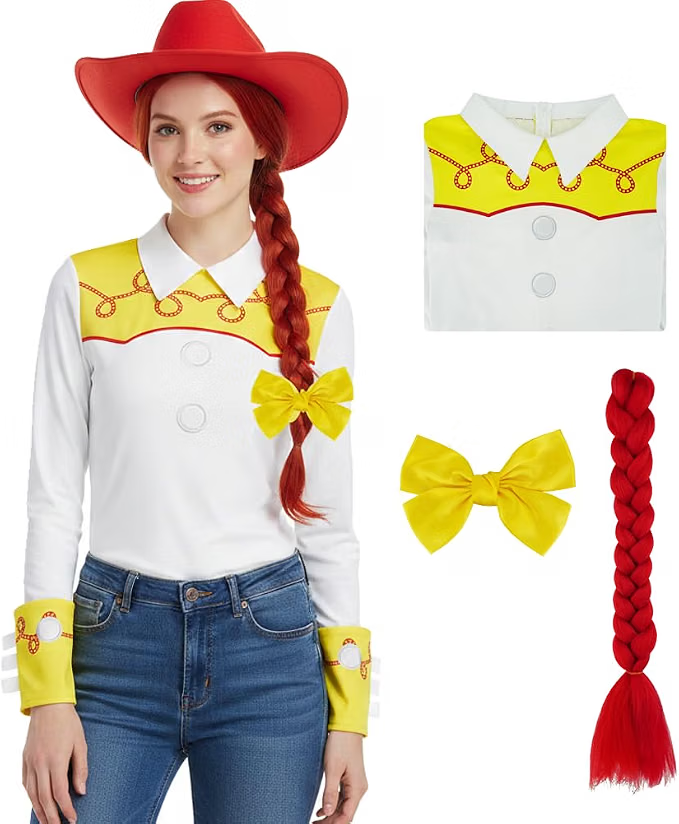
Toy Story Jessie Outfit Adult
Where to shop next
- Work team building games
- Icebreaker games for a new team
- Remote and virtual team games
- Games for an away day or conference
- Games for a leaving do or retirement party
- Games for a work BBQ or family fun day
- Two-minute games to start a meeting
- Work quiz rounds (non-Christmas)
- Office games HR won't object to
- Office Christmas party games
- Board games hub
- Quiz questions and rounds
- Free feel good tools
- Shop leaving and thank you cards
- Planning the party? Birthday party ideas
- How to make a balloon arch
- Photo booth prop ideas
- Pin badges
- All guides
Frequently asked questions
What activities work on a training day for adults?
Ones that demonstrate a point in under fifteen minutes: back-to-back drawing for briefing, the paper tower for prototyping, ball pass for iteration and desert island ranking for group decisions.
How do you make training fun without being cringe?
State the point of each exercise up front, keep it under fifteen minutes, and never ask anyone to perform, sing, dress up or share something personal. Give people a non-participating role if they want one.
What's a good energiser for a training session?
Stand-up-and-swap-seats, a two-minute walk and talk in pairs, or rock paper scissors knockout for a big room. Two to four minutes, then straight back into content.
How often should you break during a training day?
Every ninety minutes, minimum, plus a proper lunch. Attention falls off a cliff after that regardless of how good the material is.
Do you sell team building kits or games?
No - we make greeting cards, art prints and pin badges in the UK. Every game here runs with what's already in the room, and the only products on this page are our own cards.